Product management guide 1: getting to know a sector as a digital product manager
Before you build a product you have to know the sector. What to look at in a market analysis, worked through an edtech example.
Also available in Turkish This post is a translation.
Contents
- Getting to know the sector
- An example of sector research
- The basic features and services competitor applications offer to users
- Success metrics and measurement strategies of companies in the sector
- Technical and non technical risks
- National and global market size
- Audience targets and personas of competitor applications
- Revenue models and packaging in the applications
- Basic competitor analyses
- Market analyses of the mobile applications
- Conclusion

There is a settled way of teaching many different lines of work in the technology sector, but when it comes to “product management” there is usually no technical documentation about “how to do it”, only the pill sized training incubators and accelerators give about “what a product manager should do”. As someone who has moved through his technology life in a ronin style, I have made it my job to pass this knowledge to the people who come after me and to the sector. The scope of these posts will be everything to watch in digital product management at a company, from startups to enterprises, from A to Z. What I cover in this series will hold for a product person joining an established company as much as for one joining a startup that is about to be founded.
The main goal of my first post is to explain to a product person starting in a new sector how to get to know that sector at the simplest level, because you cannot build the right product without knowing the sector.
Getting to know the sector
Analysing the current state of your target line of business, nationally and globally, can be described by many terms such as market analysis, and it gives us ideas on many fronts. If we want to do a sector analysis and do it through a product person’s eyes, what we do should look roughly like this:
-
The most basic features and services competitor applications offer to users
-
The success metrics of companies in the sector and the strategies they use to measure their own success
-
The technical and non technical risks that can come up while the applications in the sector are being developed and released to users
-
National and global market size
-
The audience targets and personas of competitor applications
-
The revenue models in the applications
-
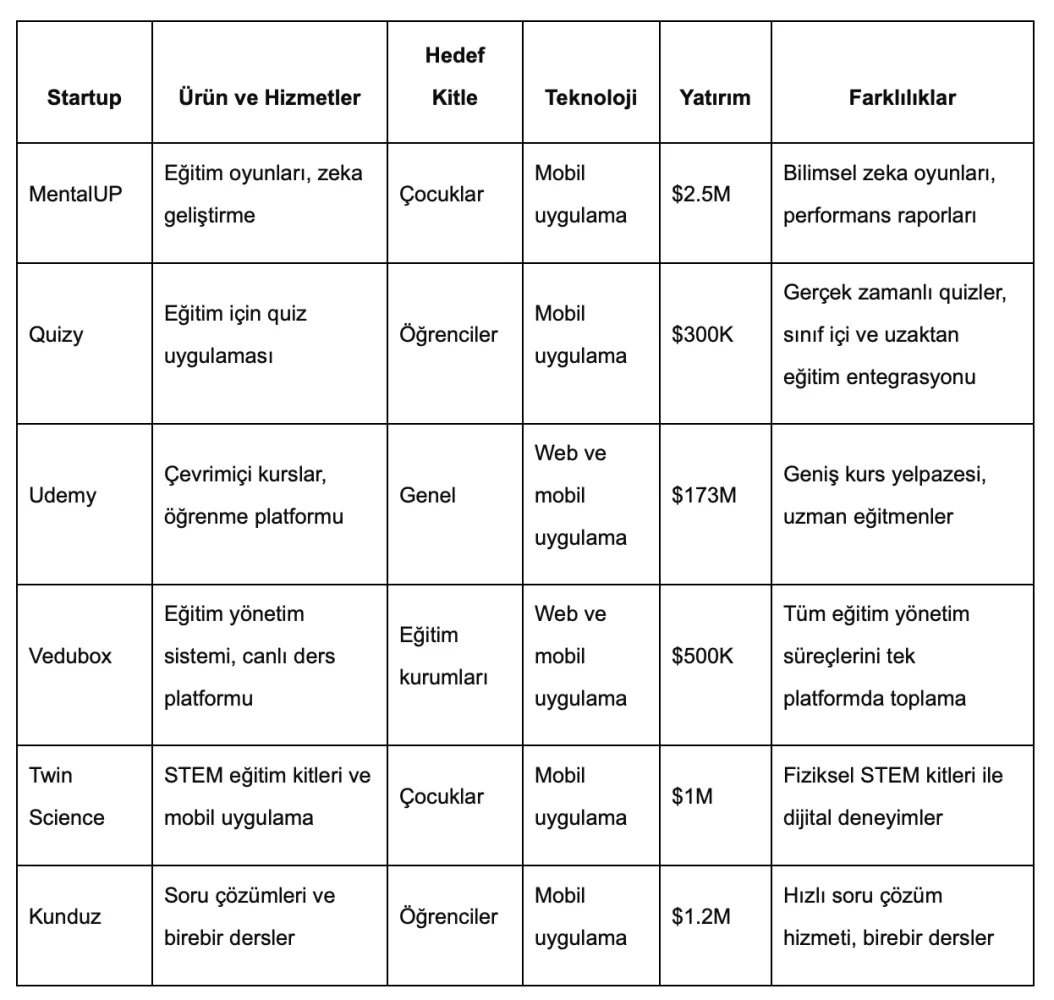
Basic competitor analyses of the main rivals in Turkey and globally (user numbers, user satisfaction, cost and effectiveness ratios)
-
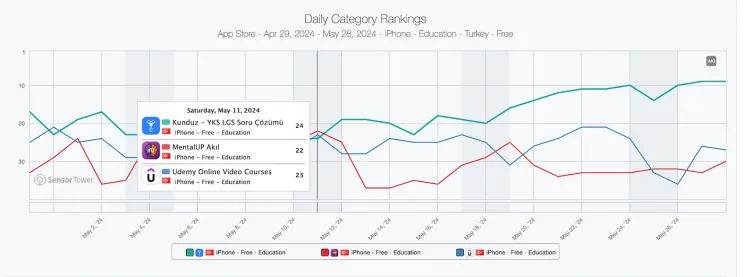
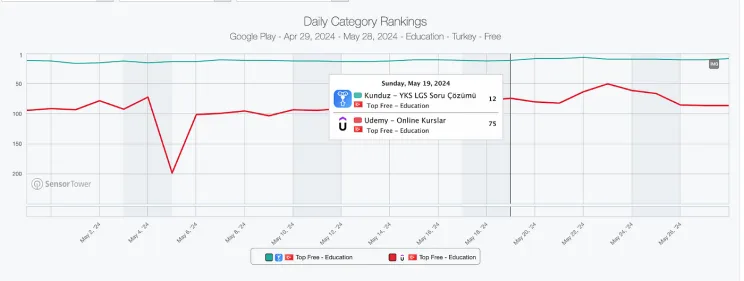
Market analyses of their mobile applications if they have them (long, medium and short term rankings and ratings on the App Store and Google Play)
-
Usage rates abroad
An example of sector research
One of the main goals of this series is to show people the basic technical knowledge above in practice. So I plan to pick a sector and go as far as building an imaginary product there from scratch. My aim is not to create a real product but to prepare a ground where I can explain the technical subjects and make the abstract concepts concrete. Education technology is a sector all of us can more or less understand, so we can start with that.
Let us go item by item:
The basic features and services competitor applications offer to users
The first thing to watch when studying a sector is the services and features the companies and applications there offer to users, because those are the reasons people need this sector at all. You have to solve the problems behind those features better, or solve them at a lower cost, or bring a very different solution to the problem. As long as you do that, you end up in a far stronger competitive position with more reasonable risk. The features below are the main ones that stood out in my research:
-
Lesson videos: topic explanations and solved questions.
-
Tests and exams: tests and mock exams at various difficulty levels.
-
Personal tracking and reporting: systems that track and report the progress of the student.
-
Interactive content: interactive homework and quizzes that get students actively involved.
-
Teacher communication: platforms where students can reach teachers directly.
-
Daily study plans: features that give students personalised study plans.
Success metrics and measurement strategies of companies in the sector
Success metrics are the test parameters that let you measure yourself in any process. If the growth in your user numbers drops below what you expected, that shows there is a problem. If user engagement is low, you can conclude that your application is not good in terms of UI and UX, or that the service you provide does not keep being useful to users. If your users do not improve their success rates after using you, that shows your application is not providing them a benefit. Metrics like these are the data you have to follow continuously in order to scale your company and your application.
-
Number of users: active and registered user counts.
-
User engagement: time spent in the application and daily, weekly and monthly active user ratios.
-
Success rate: the increase in the academic results of users, in exam scores for instance.
-
Customer satisfaction: user feedback about the application and their satisfaction levels.
-
Revenue: subscription or sales revenue of the application.
Technical and non technical risks
These are the risks we have to account for during development and afterwards. Technical risks should be solved by planning with the technical team, and we should work out ways of measuring those risks in real time. For non technical risks we should look for solutions through sector analysis and by consulting experienced people in the field.
-
Technical risks: application performance problems, data security and privacy, scalability problems.
-
Non technical risks: the quality of the educational content, alignment with the curriculum, failing to match user habits, weakness in marketing and brand awareness.
National and global market size
The education technology market is growing quickly both nationally and globally. Demand for online education tools has risen, helped along by the pandemic. In Turkey and worldwide, investment in education technology and the number of users grow significantly every year. According to Statista, for example, revenue in the online education market in Turkey was projected to reach 169.70 million dollars in 2024. That revenue is expected to grow at an average annual rate of 36.13% (CAGR 2024 to 2029) and to reach a market volume of 793.20 million dollars by 2029.
The Statista link: https://www.statista.com/outlook/emo/online-education/turkey
Note: there are many sources for market research, but I mostly use Statista for this. It is a paid service.
Audience targets and personas of competitor applications
One of the first things to do when providing a service or building an application is to define the target audience. If we are targeting primary school students in an education application, for instance, we should keep the gamification inside the application at a maximum and aim to make it more fun and interactive. In applications built for adults, on the other hand, what we watch is helping them earn certificates that give them visibility in their professional lives and letting them share those easily.
-
Primary school students: fun and interactive learning tools.
-
Middle and high school students: exam preparation and topic explanations.
-
University students and adults: professional development and certificate programmes.
Revenue models and packaging in the applications
Building the revenue model correctly matters a great deal for a venture to be sustainable. Four revenue models are used at a basic level in the education sector. How that revenue model is chosen depends on the target audience, the core features and many other factors, and it will be on our agenda later. Packaging in particular is an important subject, so for now I think touching on why it matters is enough.
-
Subscription: monthly or yearly subscriptions.
-
One off sale: selling content or courses once.
-
Freemium model: offering the basic features free and charging for advanced ones.
-
Advertising revenue: in app advertising.
Basic competitor analyses
Market analyses of the mobile applications
The rankings and ratings of mobile applications on the App Store and Google Play reflect what users think about them. In developing countries like Turkey, the fact that App Store downloads are heavier than Google Play also tells you something about the socioeconomic position of the target audience. Some companies move forward with an App Store focus only for that reason. You can do this research on many app analytics sites online. I use the free version of SensorTower.
App Store
Play Store
Conclusion
When doing a sector analysis you need deep research and evaluation across the items above. In a dynamic field like education, keeping up with conditions that constantly change and develop is critical for a successful product management strategy. These analyses will help you get to know the sector and build the right strategies.
See you in the next part.